
stand
- Object Number
- SMM248
- Name
- stand
- Description
- The stand was probably laid on the body
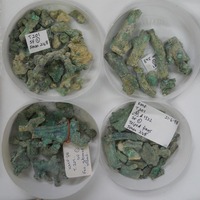
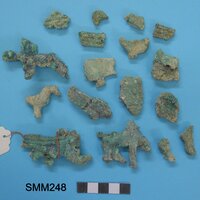
- for it seems to have been at the heart of the fire. There are 43 pieces whose approximate position in the stand can be deduced
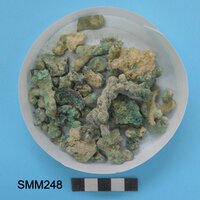
- having largely retained their original form. There are 38 pieces which have completely altered shape by fire action
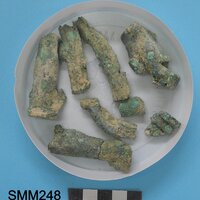
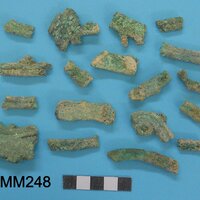
- yet can confidently be assigned to the stand.The recognizable pieces include three feet
- five sections of the vertical elements of the frame (one joining a foot)
- one transom-vertical junction (probably joining one of the vertical above)
- three transom fragments (one a junction with a vertical)
- one transom-and-strut-and- ring
- eleven strut frs.
- one strut fragment combined with dangler ring
- eleven pieces of the ajouré figurework
- four triple rod mouldings
- two five-rod mouldings (from the ring support?)
-
one unidentifiable.
The basic design consisted of a ring support resting on the four-sided frame. The vertical sides of the frame enlarged at their lower ends into feet (not zoomorphic); the vertical elements were trussed together by transoms in certainly two - possibly three registers. Struts
- made as parallel rods
-
spring from each side of each foot and were attached to the centre underside of each of the lower (lowest) transoms. A suspension ring for a dangler was attached to the underside of the struts at each apex; no danglers were identified.
The allocation of the fragments of ajouré human and animal figures to the design is impossible. Difference in scale - however
- suggests that there may have been two figured registers each side
- separated by transoms. Among the fragments can be recognized the lower part of a long robed human figure
- standing birds
- a quadruped (feline?)
- a raised wing (probably sphinx) and animal legs. The design of the ring support is also uncertain
- but it may have consisted of an ajouré wavy band bounded at the top by a band of five horizontal ring mouldings
- at the bottom
- a band of three horizontal mouldings. The object was made in Cyprus in the later thirteenth - earlier twelfth century be.
- Specimen Count
- 1
- Preservation State
- Fragment
- Collection Date From
- 1978
- Department
- Knossos
- Collection
- Stratigraphical Museum
- Other IDs
- 201.f1
- SF 1
- EMu IRN
- 44104
Part of stand