
Krater
- Object Number
- SMP7239
- Name
- Krater
- Description
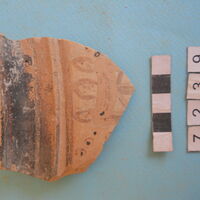
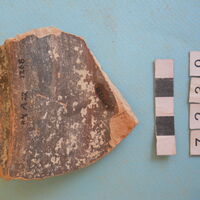
- Krater rim. PH. 0.07m. D. of rim c. 0.32m. Orange clay; dull black glaze
- flaking. Slight flange at inner edge of rim
- perhaps for a lid. Neck separated from shoulder by a shallow groove. Inside glazed. Neck glazed
- with one white stripe. Representation of a three-handled tripod lebes
- preserved down to the top of the legs. Two diagonal struts. Handles filled with dots; diagonal rows of dots on either side. LG. In Cretan Geometric the only other known picture of a tripod is on the Zeus lid
- Fortetsa pl. 107
- no. 1414. By comparison
- out tripod is rendered in much greater detail; it is
- in fact
- one of the most faithful representations in Geometric vase painting. The lebes itself is seen almost in strict profile
- with only a slight concavity along the rim; the broad and solid legs recall the vast bronze cauldrons of the mid and late eighth century - objects of prestige rather than utility. (cf. especially Miss Bentons reconstructions of the Ithaca tripods
- BSA xxxv (1934-5) 64 ff. figs 14-17). But there are two features which make it seem likely that the painter was drawing from memory
- and not from life: First the large diagonal struts cannot be matched on any surviving bronze cauldron. On the developed examples of the eighth century - e.g. those from Ithaca - the struts are proportionately much smaller; there are two to each leg
- and in no case do they come below the base of the lebes. Ampong the representations
- the nearest counterparts to our struts are those on the two clay models from an early PG grave in the Athenian Kerameikos (Benton
- BSA xxxv (1934-5) 77 fig. 1b)
- where the struts are more substantial
- and extend some way down the leg below the lebes; but if these are accurate copies of a bronze type
- then that type had surely been long out of fashion by the time of our krater. Indeed
- the struts here are so huge that one is reminded rather of the rod-tripod stand (note: but here too there are chronological difficulties. Although rod-tripods were known in Crete
- the three examples so far recorded are from contexts much earlier than LG: see H.W. Catling
- Cypriot Bronzework in the Mycenaean World (Oxford
- 1964) 198-9 nos. 18-20. In Athens
- however
- a rod-tripod was found in a grave of LG IB (Catling
- op.cit. 194 no. 6; for the date
- GGP 46).); was there perhaps some confusion in the mind of our painter between the two different types
- the stand and the cauldron? At all events
- we do not encounter these struts in any other Geometric painted representation - although it is just possible that an Argive Subgeometric vase-painter began to draw such a struc
- and then thought better of it (note: BSA xxxv (1934-5) pl. 26.2. Miss Benton
- ibid. 105 n.6
- considers the mark on the tripod-leg to be accidental.). Secondly
- the addition of a third handle
- as Miss Benton has pointed out (loc. cit. 105)
- is surely a negation of function; for if the vast tripods of the eighth century were ever used for cooking
- they could only be removed from the flame by means of a pole inserted through two diametrically opposite ring handles. But the rendering of three handles
- one opposite each leg
- indicates a perfectly natural misunderstanding in the mind of our painter
- working conceptually rather than from direct observation. A similar mistake evidently occurred on an Attic LH IIb vase from the Acropolis
- of which only a fragment survives (note: Ibid. 105 no. 12
- fig. 13b.). Finally
- dots seem to be a favourite filling ornament in Geometric tripod representations (note. Ibid. 102 ff. nos. 1 (Paris A 547)
- 2
- 3
- 8
- 9
- 15
- 17
- 23). Miss Benton wondered (note: ibid. 106 n.4) whether they might not indicate fillets for the victors in a contest
- such as were once hung on a tripod in the Temple of Zeus at Olympia (Paus. V.12.5). Our piece is too fragmentary to supply any new information on this issue; but the diagonal dot-rows do seem to lead the eye outwards from the tripod
- as though it were the centre of an antithetical composition: the prize
- perhaps
- for a pair of contestants - athletes or horses - confronting one another on either side.
- Specimen Count
- 1
- Preservation State
- Fragment
- Department
- Knossos
- Collection
- Stratigraphical Museum
- Other IDs
- G83
- EMu IRN
- 91552
Part of Krater